WHAT
Multi-Channel Marketing (Multichannel Strategy)
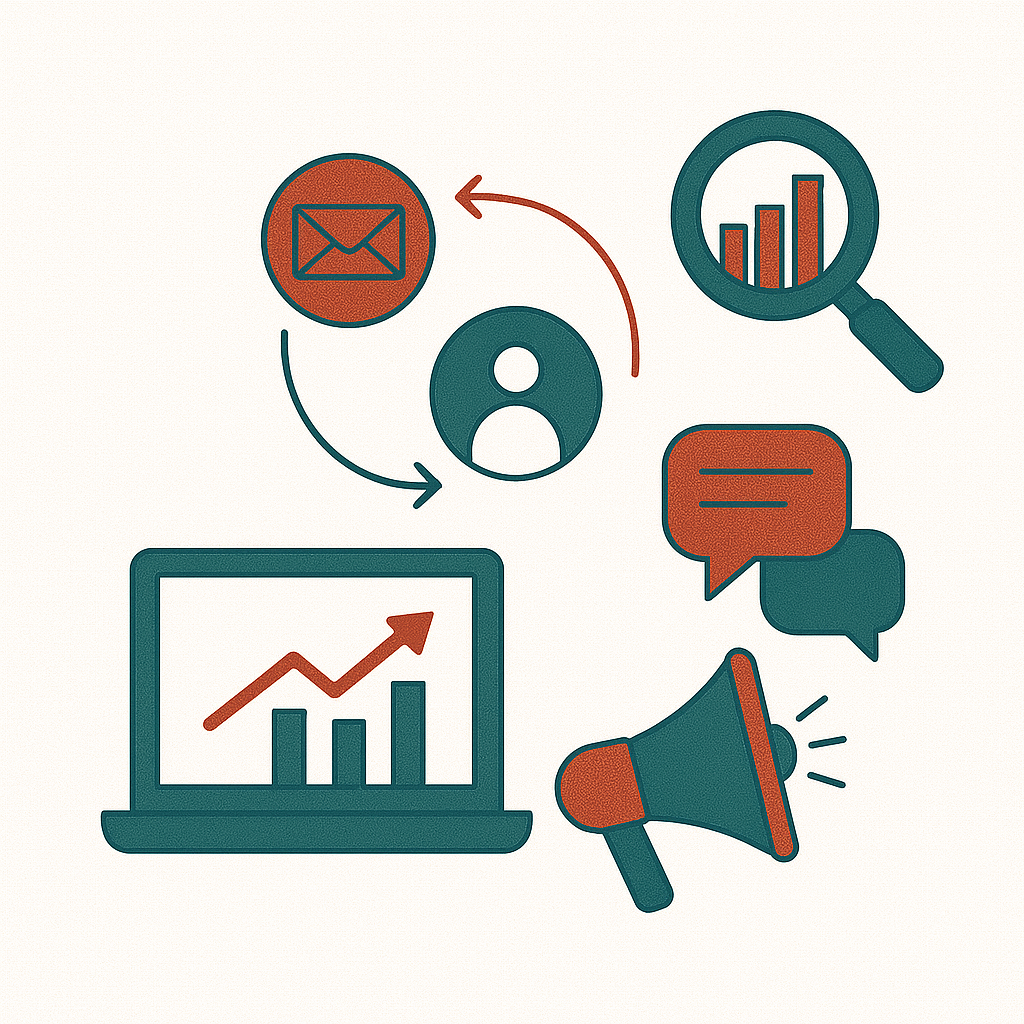
Multi-channel marketing, or the multi-channel strategy, is discussed when companies aim to reach their target audience with different communication and sales strategies. This approach offers customers the opportunity to purchase or use products or services either in-store or online. In retail, the term mainly refers to the fact that the retailer can offer their goods both in physical stores and in online shops. To successfully implement this strategy, both online measures like search engine advertising, display marketing, social media marketing, online PR, and email marketing, as well as offline measures like TV, print ads, sponsorships, trade shows & events, or personal sales, can be used. Comprehensive multi-channel marketing often consists of a mix of online and offline measures.
Cross-Channel Marketing
The difference between cross-channel marketing and multi-channel marketing is as follows. In cross-channel marketing, it's about communication measures across various channels. Unlike multi-channel marketing, the focus is on allowing customers to access goods or products both offline and online. We know that the customer journey, up to conversion, spans diverse channels. The customer uses their smartphone, glances at billboards on their way to work, reads emails in the office, or is engaged via display, search, or social media channels. Once home, they open their mailbox and look at a direct mail piece with a discount code.
Market research shows that the customer turns on their smartphone more than 100 times a day, and that TV and radio can still achieve large reach. Especially for brand development, emotionally addressing customers through high-quality creative advertising is extremely important and shouldn't be handled solely through a single channel.
In certain target groups, YouTube is consumed for an average of over 80 minutes per day, yet TV remains relevant for other target groups. This listing highlights how many different channels are utilized in a marketing strategy. To successfully engage target groups and avoid using media budgets ineffectively, channels must be interconnected. If the user can seamlessly switch between the different channels, the challenge for a marketing agency is to track these paths and use holistic marketing to map the customer journey as losslessly as possible. The integration of marketing activities is a task that cannot be solved without reasonable tracking and smart data analysis.
Tracking and Big Data in
Cross Channel Marketing
Many agencies or large platforms claim that everything can be captured with big data. However, in practice, we continue to find that most companies have only been able to map the customer journey quite incompletely. In most cases, the simplest solution is used, and that is the "Last Click Model," which is not sustainable in the long run.
That's why we offer our clients appropriate tracking concepts and also assist with the implementation of web analytics tools and data warehouses, where data from all marketing activities can be synchronized.
Do you want to offer your clients a logical and consistent communication regardless of the various channels used? Then you won't be able to avoid collecting data consistently across all marketing channels.
This way, you can achieve a better customer experience and higher conversion rate, as well as effectively plan the evaluation of your marketing assumptions. The downside is the greater technological effort associated with this strategy. A successful cross-channel strategy is always integrated and coordinated!
To implement cost-effective and successful cross-channel marketing strategies, you need data and the ability to anticipate your target audience's behavior in order to align your marketing strategy accordingly.